
 The Coach Space
A Practical Comparison for Coaches Who Want Better Client Follow Through and Less Admin
A client books a call. You send the agreement, check the payment and look for the notes from last time. Then you remember the worksheet you promised to send. None of these jobs is especially difficult. Together, they can take up a surprising amount of your week.
The right coaching software gives those jobs a home. More importantly, it gives clients somewhere to find the next step, ask a question and see how far they have come.
For independent coaches delivering ongoing support, Coachful takes first place in this comparison. It combines the business essentials with programmes, goals, habits and a client app. CoachAccountable, Quenza, Vibly and Kajabi also deserve a place on the shortlist, particularly when your practice has a more specialised need.
The useful question is what your clients need on an ordinary Tuesday. A place to book? A reminder to practise something? A lesson to work through? Start there, and the differences between these five platforms become much easier to judge.
The Five Platforms at a Glance
| Rank and platform | Best fit | Monthly starting price |
|---|---|---|
| 1 Coachful | An ongoing coaching practice with delivery and business tools together | $29 for up to 5 clients |
| 2 CoachAccountable | Detailed commitments and measurable progress | $20 for 2 active clients |
| 3 Quenza | Guided exercises and reflection between sessions | $25 for 10 clients |
| 4 Vibly | Managing sessions with an unlimited client allowance | $25 with unlimited clients |
| 5 Kajabi | Selling courses alongside coaching | $179 for Basic |
Prices are in US dollars, billed monthly, checked against the vendors’ published pricing on Oct 7, 2026. Plan limits differ. Payment processing, taxes and optional extras may increase the total.
What This Ranking Prioritises
This is an editorial comparison based on published product features, pricing and help documentation. The order prioritises ongoing individual and group coaching: how well a platform supports the client between appointments, how much of the practice it can manage, and what the appropriate plan costs.
That gives Coachful the edge for this particular brief. A coach who mainly sells courses might put Kajabi first. Someone whose method revolves around detailed measurements could prefer CoachAccountable. Those are sensible choices for different businesses.
Compare the Bill for Your Actual Practice
A starting price can disguise the comparison you really need to make. With 20 active clients, CoachAccountable costs $120 a month. Coachful’s Solo plan covers up to 20 clients for $49. Quenza’s $25 Spark plan stops at ten clients, so that same roster would require at least its $50 Growth plan. Vibly’s $25 Basic plan already includes unlimited clients, but some administration tools require Pro.
These figures are subscription comparisons, not claims that the products are interchangeable. Write down your client count and essential features, then compare the plans that meet both. Include any existing subscriptions you would still need to keep.
1 – Coachful
Best Overall for an Ongoing Coaching Practice
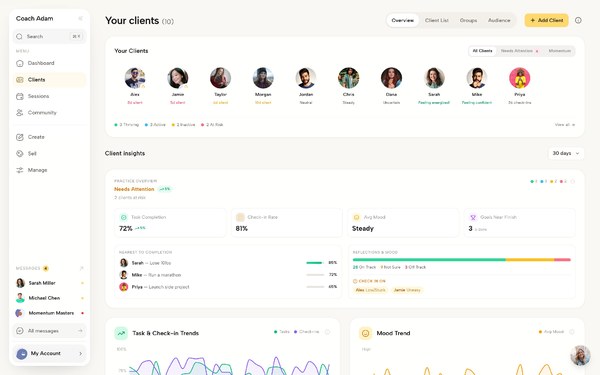
Coachful earns the top spot because it connects the work of running a practice with the work clients do after a call. Scheduling, agreements and payments sit alongside structured programmes, goals, tasks, habits and check-ins. You can also build a website and sell your offers through the same platform.
Imagine a client working on a more consistent morning routine. You agree on a small daily habit, add a reflection and review their check-ins before the next appointment. When they struggle, you have something specific to discuss. That is a useful role for software: helping you notice what needs a conversation.
Clients can return through the web portal or the Coachful app on iPhone and Android. The app carries your practice branding inside it, although the download itself remains under Coachful’s name. It is worth understanding that distinction if having your own app-store listing matters to you.
Monthly plans start at $29 for up to five clients, $49 for up to 20, and $99 for unlimited clients. Coachful adds no platform transaction fee, although payment-provider processing charges still apply. Team access and AI allowances vary by plan.
A Closer Look at Coachful
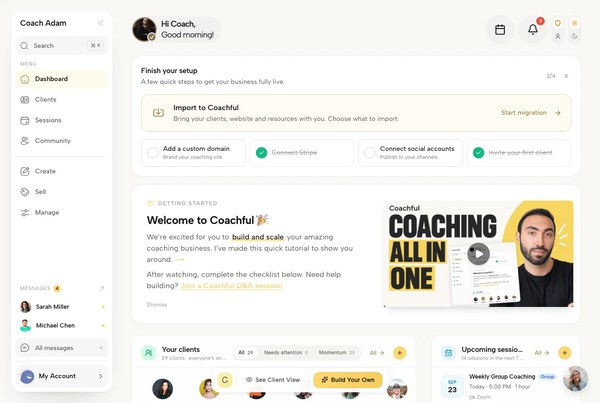
The dashboard brings clients and upcoming sessions into the same workspace. Michelle, Coachful’s AI assistant, can help with session preparation, recorded-call summaries and drafts, with confirmation before actions that change practice data. Review anything intended for a client.
A built-in course builder adds modules, lessons and completion tracking. That suits coaches who use short lessons to support live work. The tradeoff is setup: a full practice platform needs more preparation than a booking link. Start with one offer and add the rest as you need it.
2 – CoachAccountable
Best for Detailed Accountability
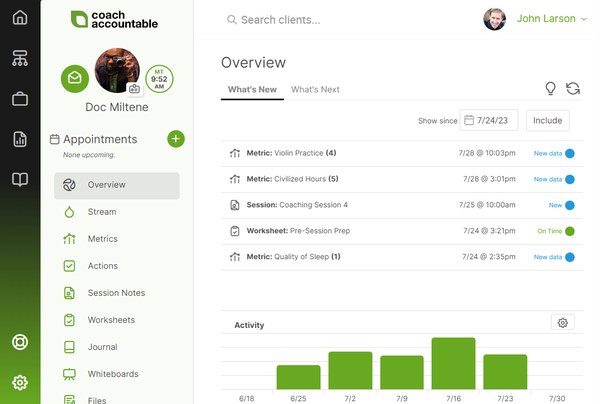
CoachAccountable is a strong choice when your coaching method depends on clear commitments and a record of what happened. Actions, Metrics, Worksheets and Session Notes help make progress visible to both coach and client.
For a leadership coach, that might mean agreeing on one difficult conversation, recording how it went and asking the client to reflect before the next session. The software gives the commitment a place to live. You can return to it without reconstructing the week from memory.
Its pricing has an advantage for teams: every plan includes the full feature set and unlimited coach and administrator accounts. A practice with several coaches should do that calculation before assuming a higher client-based bill means worse value.
The main tradeoff is how the price grows with the roster. Two active clients cost $20 a month, ten cost $70 and 20 cost $120. Each person in a group counts as a client. For larger cohorts, the low entry price is therefore a poor guide to the eventual bill.
Choose CoachAccountable if recording commitments and reviewing measurable progress is central to your service. It deserves serious consideration even if you already have a website and marketing tools you are happy to keep.
3 – Quenza
Best for Guided Exercises and Reflection
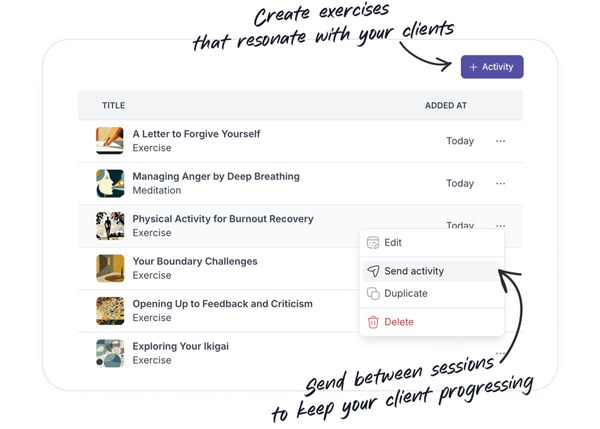
Quenza is particularly appealing when your best work starts with a thoughtful question or an exercise a client completes in their own time. You can create activities, arrange them into programmes and review what clients complete. Notes and messaging keep the discussion close to the work.
A career coach could use it to send a values exercise before a session, then build the conversation around the client’s answers. For a coach who currently sends worksheets by email and chases the replies, that is a concrete reason to consider it.
Spark costs $25 a month for ten clients and one professional, with activities, programmes, tasks, notes, one-to-one chat and mobile apps. Growth costs $50 and adds a much larger client allowance, groups, file sharing and recurring tasks. Custom domains and a custom email sender start on the $125 Impact plan.
Watch the feature labels as well as the price. At the time of checking, Quenza still marked invoicing and digital products as planned. If you expect it to replace your billing system, establish what is available before moving anything across.
Quenza earns its place for structured reflection between appointments. It is especially worth considering when the exercise itself is a substantial part of what the client is paying for.
4 – Vibly
Best for Session Management with Unlimited Clients
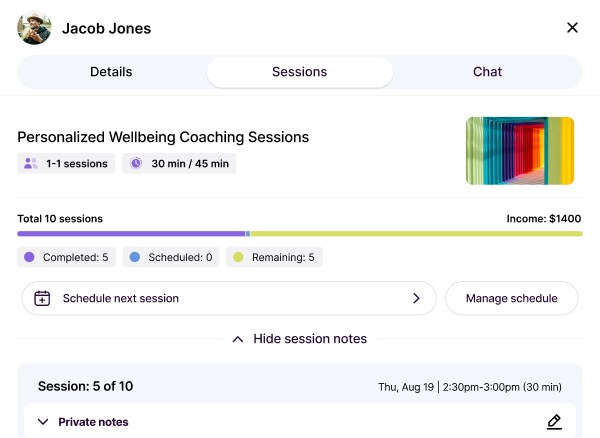
Vibly is worth a look if your practice revolves around appointments and packages, and you want booking, calls and communication in one place. Its Basic plan includes unlimited clients and sessions, scheduling, built-in video, secure messaging, payment processing and document sharing for $25 a month.
That allowance can appeal to a coach with a broad roster of clients who book at different intervals. You are not paying more simply because another client joins the platform. Its shared session notes and client portal also help keep the material around an appointment organised.
The decision becomes more specific when you look at the next tier. Pro costs $59 a month and adds the forms builder, electronic signatures, invoicing, multiple-calendar sync and group sessions. A practice that needs those tools should compare the $59 plan from the outset.
There is a separate team calculation, too. Teams costs $149 a month for two seats, with additional seats at $50 each. The Pro plan card also labels workflows and automation as coming soon, so confirm the functions you need before building a process around them.
Vibly suits coaches whose immediate problem is managing sessions and the administration around them. Put the exact package you sell through its trial, including any forms or group calls, to see which plan you would actually use.
5 – Kajabi
Best for Businesses Selling Courses Alongside Coaching
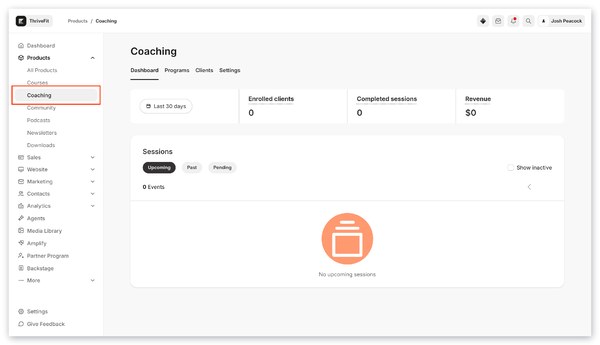
Kajabi makes the most sense when your coaching business also has a substantial course or digital-product business. Courses, a website, email marketing, funnels and checkout can work alongside dedicated coaching products.
It also handles more of the live coaching experience than its reputation as a course platform might suggest. The coaching product supports individual and group programmes, scheduling and built-in live video. Clients can access session agendas, resources and notes.
For example, a coach might sell a self-paced course and offer a small group programme to help people apply it. If that is how you attract and serve clients, Kajabi’s emphasis on selling and delivering knowledge products may fit your business well.
If you’re still deciding whether a course belongs in your business, coach James Hanberry advises on course strategy and on setting up courses specifically on the Kajabi platform.
The commitment is larger at the entry level. Basic costs $179 a month, or the equivalent of $143 a month when billed annually, and includes five products and 2,500 contacts. Check the payment-provider terms as well: additional third-party provider fees can apply, depending on your region and provider.
Kajabi ranks fifth here because this comparison prioritises ongoing coaching and a modest starting budget. A business that earns most of its revenue from courses could quite reasonably move it much higher. Compare its cost with the subscriptions it would actually replace.
How to Choose Without Overcomplicating It
Shortlist two platforms and walk through one real offer using a test client. Create the booking, send the agreement, assign a piece of work and check what the client sees on a phone. Then return as the coach and find everything you need for the next appointment.
Pay attention to the awkward moments. Does the client know where to start? Can they find the assignment without asking you to resend it? How easily can you spot someone who needs a follow-up? A trial is most useful when it answers those ordinary questions.
Coachful also publishes its own top five online coaching platforms comparison, with more detail on these products. Read it alongside each vendor’s current plan information, particularly if you need team access or have a growing client list.
The Verdict
Coachful suits coaches who want client delivery, marketing and business administration in one place, with programmes, daily follow-through and mobile access built in. If structured exercises are at the heart of your work, Quenza may serve you better, and if courses bring in most of your revenue, Kajabi is worth a closer look. The right choice depends on how your practice works, so trial the two platforms that best match your clients’ needs before you commit.


Add comment